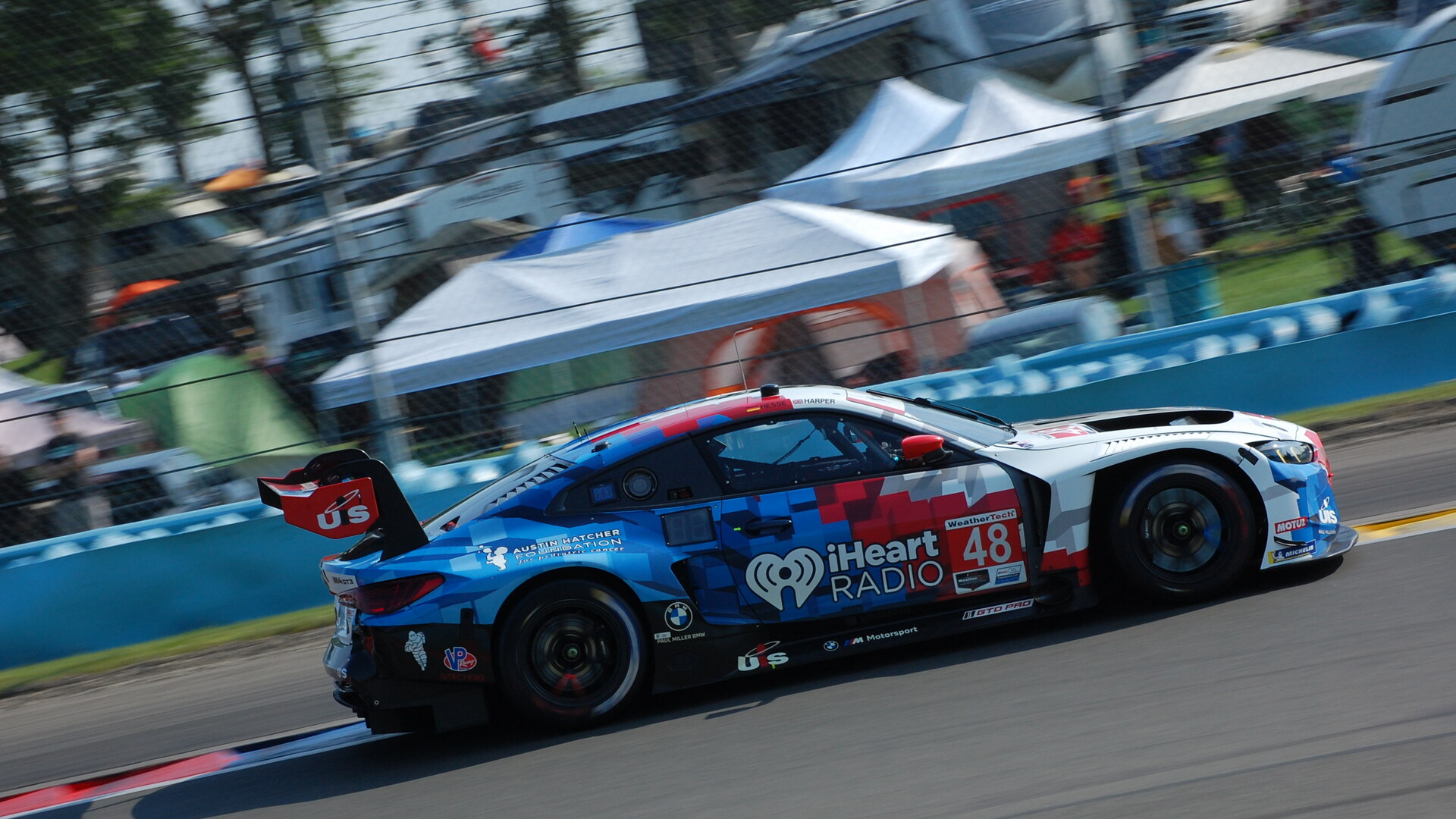
Hanley Motorsports Incorporated is building its 2027 IMSA operation by combining assets and people that already know the paddock rather than starting with an empty workshop. The result is a planned four-car BMW programme spanning the WeatherTech SportsCar Championship and Michelin Pilot Challenge — and a useful case study in how a new race-team brand can buy time without buying certainty.
IMSA confirmed on 4 November that HMI will join forces with DXDT Racing and run BMW M4 GT3 EVOs in GTD PRO and GTD, plus BMW M4 GT4 EVOs in the GS class. Independent reporting by Sportscar365 adds the transaction detail: Robert Hanley acquired Paul Miller Racing's assets, including two GT3-specification BMWs, while the targeted two-car Pilot Challenge programme is waiting for its GT4 machinery. RACER and DailySportsCar independently report the same four-car structure.
The launch therefore joins three operating layers. There is DXDT's active team capability and personnel, Paul Miller Racing's cars and Buford workshop, and HMI's capital and new identity. HMI says a purpose-built facility is being completed in Flowery Branch, Georgia, while the organisation will use the former Paul Miller Racing premises during 2027. Mitchell Simmons becomes team principal and Bryan Sellers competition director.
That structure is commercially more consequential than a normal entry announcement. It brings together vehicle assets, technical knowledge, employment relationships, workshop capacity and championship rights under one new name. It also compresses a multi-year growth plan into the period before January's Roar Before the Rolex 24.
An acquisition-led route to the grid
The conventional clean-sheet route into GT racing is slow. A new team must source cars, spares and support equipment; recruit people who understand the platform; secure premises; build data and operating procedures; and then demonstrate enough delivery credibility to attract drivers and partners. HMI has shortened several of those steps by acquiring operating assets and aligning with an established team.
The two acquired BMW M4 GT3 cars matter because they reduce a major platform-transition risk. Paul Miller Racing competed with BMW in IMSA, so the assets, setup history, tooling and some available knowledge are tied to the same manufacturer HMI intends to represent. The official BMW IMSA record also identifies Paul Miller Racing and Turner Motorsport among its established GT teams, placing the inherited programme inside a mature customer-racing ecosystem.
DXDT brings another kind of continuity. It has current race-team processes, supplier relationships and personnel who have operated under pressure. Sportscar365 reports that DXDT and former Paul Miller staff will come together under HMI and that the DXDT name will become inactive. That makes this an operational combination rather than a badge placed on an unchanged entrant.
For a buyer, that can be faster than building. It is not automatically cheaper or simpler. The undisclosed acquisition price is only one component of the investment. HMI must still fund four race cars, race entries, testing, rebuild cycles, transport, tyres, staff, insurance and working capital. The new facility adds construction and fit-out requirements while the temporary use of an existing shop creates a second transition to manage later.
No party has published the purchase price, the ownership allocation, individual programme budgets, the terms of the DXDT combination or the commercial level of BMW support. Those gaps matter. They prevent a reliable valuation of the deal and mean the acquisition should be read as a delivery strategy, not evidence that the financial risk has been removed.
Four cars create a portfolio, not just a bigger team
The planned entry comprises one GTD PRO BMW, one GTD BMW and two GS-class GT4 BMWs, according to the independent reports. That gives HMI two cars at the top of IMSA's GT structure and two development cars in Michelin Pilot Challenge. For sponsors, drivers and suppliers, it creates inventory across two championships and three classes rather than a single-car proposition.
Commercially, that can widen the addressable market. A partner seeking factory-adjacent performance can be placed around GTD PRO. A customer or sponsor prioritising driver participation may fit GTD. Companies looking for a more accessible activation or development story can use the GT4 programme. Shared branding, hospitality and content can then be sold across the portfolio while race-specific assets remain class-appropriate.
The portfolio can also spread fixed costs. Management, finance, marketing, workshop systems, transport planning, data infrastructure and some supplier contracts can support more than one car. The benefit depends on disciplined allocation. If shared functions become bottlenecks, four cars multiply demands faster than revenue.
The same is true of parts and engineering. Staying with BMW across GT3 and GT4 simplifies the manufacturer relationship and brand proposition, but the two models do not create one interchangeable inventory. Each programme still needs its own spares forecast, setup knowledge, test plan and technical compliance. The GT4 cars had not yet arrived when the programme was announced, so their delivery and commissioning remain a critical dependency.
For suppliers, the scale is meaningful. A four-car operation can require transport and workshop equipment, pit hardware, data systems, radios, simulation, composites repair, fabrication, fasteners, fluids, protective clothing, catering, travel, staffing and logistics services. Vendors should, however, confirm whether HMI, an inherited operating entity or a class-specific programme will place orders and carry payment responsibility. A new brand assembled from existing operations can otherwise produce ambiguous purchasing authority.
The ladder has to work for employees as well as drivers
HMI says it wants its GT4 programme to develop drivers, engineers, mechanics and administrative staff for GT3. That is more ambitious than the usual driver-ladder language. If implemented, it can turn the two-car GS operation into a workforce pipeline for the WeatherTech programme.
The logic is strong. Motorsport teams compete for experienced people, and recruiting every GT3 role from outside is expensive. An internal path gives junior staff exposure to the same organisation, manufacturer culture and race-weekend discipline before they move into higher-complexity roles. It can also improve retention by making progression visible.
But an entry list is not a training system. HMI needs defined competencies, mentoring, review points and documented procedures if a mechanic or engineer is to move safely between programmes. Data access, car-specific training and decision authority must be explicit. Administrative staff need the same structure around travel, customs, purchasing, sponsor delivery and compliance.
The progression model also has a capacity cost. Senior GT3 personnel must spend time teaching and reviewing, particularly during the first season when the senior programme is itself being integrated. The organisation should budget mentoring as productive work rather than treating it as spare-time activity.
The launch names Simmons and Sellers in clear leadership roles, which helps. Simmons previously led Paul Miller Racing, while Sellers has recent DXDT management experience and a long history with Paul Miller. Their shared knowledge can bridge groups that might otherwise arrive with different processes and loyalties. The next evidence will be the wider organisation chart: engineering leads, crew chiefs, sporting management, commercial leadership and the reporting line between the two championships.
A temporary shop reduces schedule risk but creates a second changeover
Using the former Paul Miller Racing shop in Buford gives HMI an operational base while the new Flowery Branch facility is completed. This is a sensible sequencing decision. The cars and some related equipment can remain in a known environment, and preparation does not need to wait for construction.
The bridge facility also limits the number of unknowns before Daytona. Workshop utilities, access, storage and familiar workflows can support early testing while the new building is fitted out. The team says it intends to run before the Roar, so every avoided move before January protects preparation time.
The trade-off is that HMI must plan two transitions: one into the combined organisation and another into the new facility. Moving race cars, spares, machinery, IT, data storage and controlled inventory during a season can disrupt availability if the cutover is treated as a property exercise rather than an operational programme.
Sportscar365 reports a target of late 2027 for the new base, while the official IMSA announcement says only that it is being completed. The parties have not disclosed the building's size, cost, ownership, construction contract or final opening date. HMI should therefore preserve schedule flexibility and stage the fit-out around racing milestones.
For prospective suppliers, the facility creates opportunity but also a qualification question. Workshop systems bought for Buford may not fit the final layout. Equipment proposals should separate portable assets from building-specific installations, identify lead times and define who owns design changes. Long-lead items such as lifts, power distribution, compressed air, networking, secure parts storage and vehicle loading equipment need an acceptance plan tied to the actual building schedule.
Integration is the first competitive programme
The headline risk is not whether each component can race. DXDT and Paul Miller personnel have already demonstrated that. The risk is whether the combined organisation can make fast, consistent decisions as one team.
HMI should establish a single operating model before the first full test. That means one authority matrix for sporting calls, technical sign-off, procurement, hiring and communications. It means deciding which setup and data conventions survive, who owns the master parts list, how build records are controlled, and which entity signs contracts. It also means protecting confidential customer and driver information during the transition.
Culture matters because race teams encode experience in habits. Two competent groups may use different naming systems, approval thresholds, setup sheets or escalation routes. If those differences surface for the first time at a race, the cost is time. A pre-season integration plan should deliberately test handovers, pit equipment, data flow, radio protocols, parts traceability and incident response across all four cars.
Supplier consolidation will be another decision. Keeping incumbent vendors preserves continuity; combining volume can improve terms and reduce complexity. HMI should not force consolidation where a vendor's knowledge is car- or crew-specific. A phased review after Daytona would produce better evidence than immediate across-the-board changes.
The January deadline makes sequencing critical. HMI does not need every long-term system finished before the Roar. It does need the safety-critical and race-critical stack to work: prepared cars, licensed entries, named crews, spares, transport, communications, data, travel and clear decision rights. Marketing systems and new-facility optimisation can follow without compromising the first race.
What partners and the paddock should watch
The first indicator is whether HMI completes meaningful testing before the Roar, as stated in the official announcement. Running all intended platforms would show that car delivery, staffing and basic systems have moved from plan to operation. Delays would not prove failure, but they would increase the amount of validation pushed into the event window.
The second is personnel retention. The transaction's value rests partly on knowledge embedded in DXDT and Paul Miller people. Leadership titles alone do not reveal how many engineers, mechanics and support staff will transfer, remain through the season or move between GT4 and GT3. Recruitment announcements and race-weekend rosters will make the integration more measurable.
The third is commercial packaging. The launch did not identify drivers, sponsors, customer arrangements or the scope of BMW's support. Those announcements will show whether HMI can monetise the four-car structure as a connected platform or must finance each entry separately.
The fourth is the facility timetable. A visible construction and equipment plan would give suppliers a realistic basis for proposals and reassure staff that the temporary arrangement has an executable end state. The late-2027 timing reported independently should be treated as a target until HMI confirms it.
Finally, watch the internal ladder. Promotions between the GS and WeatherTech programmes, shared training and repeatable technical processes would validate the most distinctive part of HMI's proposition. Without them, the GT4 entries remain useful race cars but not the workforce system being promised.
HMI has assembled a credible shortcut to IMSA scale: acquire the right platform assets, combine experienced people, retain a functioning shop and build a larger home in parallel. The commercial opportunity is substantial because the operation can serve sponsors, drivers, employees and suppliers across four cars. The execution burden is just as concentrated. Before the programme can prove itself on track, it must show that three inherited components can operate as one company.