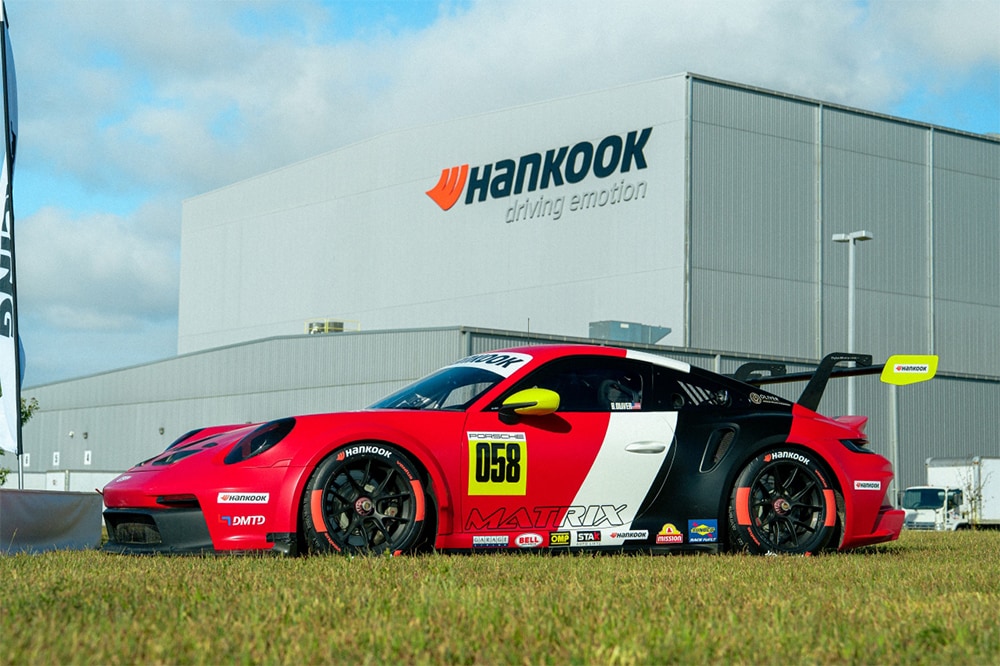
Hankook's new five-year agreement with Racing America is more than a sponsorship renewal. It creates one supply and service platform across four championships with different cars, customers and technical demands.
From 2027 through 2031, Hankook will be the official tyre partner and exclusive racing-tyre supplier for the Trans Am Series, International GT, Formula Regional Americas and the Formula 4 United States Championship. The deal adds Trans Am and International GT to Hankook's North American portfolio while extending its existing Formula Regional and F4 relationships, which the company says began in 2019.
The parties signed the agreement at Hankook's Tennessee plant on 25 September and announced it on 29 September. Contract value, team tyre prices, allocation limits and detailed technical specifications were not disclosed.
For teams, series operators and suppliers, the most important point is the scope. Hankook is not simply buying category rights and providing product. Its confirmed brief includes tyre supply, technical and engineering support, trackside service and joint marketing activity across all four properties.
One contract, four operating environments
The championship mix gives Hankook exposure to several parts of the North American racing market. Trans Am covers high-output road-racing machinery and a long-established competitor base. International GT serves customer teams running premium sports cars. Formula Regional Americas and F4 U.S. sit on the single-seater development ladder.
That variety can create scale, but it does not make delivery uniform. Each series has different car weights, power levels, aerodynamic loads, race formats, testing needs and participant budgets. A tyre that suits one category cannot be assumed to suit another without a category-specific construction, compound, operating window and support plan.
The five-year term gives the supplier time to forecast those requirements and amortise development work. It also gives Racing America a longer horizon for regulations, event operations and competitor communication. The commercial advantage depends on whether the parties turn that horizon into stable specifications and reliable service rather than simply a longer branding cycle.
Racing America said detailed tyre specifications, competition rules, technical-support programmes and team-onboarding information will be announced before the 2027 season. Until those documents appear, competitors still lack the information needed to calculate tyre budgets or plan testing around the new arrangements.
Trackside service becomes part of the product
Exclusive supply contracts concentrate responsibility. When every entrant depends on one approved product, manufacturing consistency and event logistics become sporting issues as well as commercial ones.
Hankook will need to estimate demand across four calendars, produce and quality-control the required inventory, move it to circuits, manage fitting and returns, and maintain enough engineering capacity to diagnose problems. Teams will judge the programme through availability, batch consistency, technical response and the clarity of operating guidance.
The official announcements confirm engineering resources and trackside support but do not publish staffing numbers, response commitments or contingency arrangements. Those details will matter when events overlap or when one category needs additional stock after testing, weather changes or an unexpected wear pattern.
Racing America can gain efficiency by coordinating one tyre partner across its portfolio. Common ordering processes, paddock equipment, data formats and support contacts may reduce duplication. That benefit should not be overstated: the service still has to be tailored to each championship, and any disruption can affect several properties at once.
For other suppliers, the agreement is a useful example of how a rights holder can aggregate demand. A component or service company may be able to justify better infrastructure when it can address several series through one commercial relationship. In return, the rights holder should expect stronger capacity planning, category-specific expertise and measurable service levels.
The formula ladder supplies a working baseline
Hankook is not entering every part of the platform from zero. Its Formula Regional Americas and F4 U.S. relationships provide several seasons of data on the cars, circuits, competitor behaviour and operational demands of Racing America's single-seater championships.
That installed base reduces part of the transition risk. Ordering systems, trackside processes and technical contacts already exist, even though the 2027 regulations and service package may change. It also gives Racing America a reference point when onboarding Trans Am and International GT teams.
The two new series broaden the challenge. GT and Trans Am competitors may have different expectations on compound choice, tyre life, testing access and event service. Racing America will need to explain not only what changes, but also why the package is appropriate for each category and how competitor feedback will be handled during the introduction.
The agreement's value to teams will therefore be measured in the total cost and quality of participation, not only in the price of an individual tyre. Predictable availability, useful engineering advice and consistent performance can reduce wasted running. Poor communication or supply volatility can erase the apparent benefit of a standard platform.
Marketing rights sit on top of the supply relationship
Hankook will also receive event branding, digital and broadcast exposure, social-media opportunities and fan-engagement inventory. That makes the deal both a business-to-business supply contract and a consumer-marketing platform.
The company can demonstrate its product in competition while speaking to different audiences: performance-car customers in Trans Am and International GT, aspiring drivers and families in the formula ladder, and trade customers involved in preparation and distribution. Its Tennessee manufacturing presence gives the North American programme a domestic industrial connection that can support dealer, employee and customer hospitality.
For Racing America, the partnership packages a necessary technical input as a rights asset. The organiser can sell visibility and content around a supplier whose product is used in every session, while the supplier gains a credible reason to be present in team and fan communications.
The published material does not disclose a separate activation budget, broadcast deliverables or category-exclusivity outside racing tyres. Those omissions matter because rights value depends on what the supplier can actually use, how often it appears and whether the organiser can provide reliable audience and engagement data.
What teams should seek before 2027
Competitors now need the operational terms. The priority list includes tyre and fitting prices, per-event allocations, wet-weather availability, compound specifications, testing rules, ordering deadlines, return policies and the process for escalating technical concerns.
Teams also need enough notice to adapt setup work and budgets. Formula cars may retain a familiar product family, while Trans Am and International GT entrants could face a larger change in baseline data and spares planning. The earlier the specifications are fixed, the less pre-season mileage will be spent recreating basic knowledge.
Series management should publish a clear transition timetable and distinguish mandatory sporting rules from supplier recommendations. It should also explain how feedback is collected without allowing individual teams preferential access to information.
Hankook and Racing America have established the commercial framework: four championships, five seasons and an exclusive combination of product, service and marketing. The business test begins when that framework is converted into prices, specifications, staffing and dependable delivery for the competitors who will fund and use it.