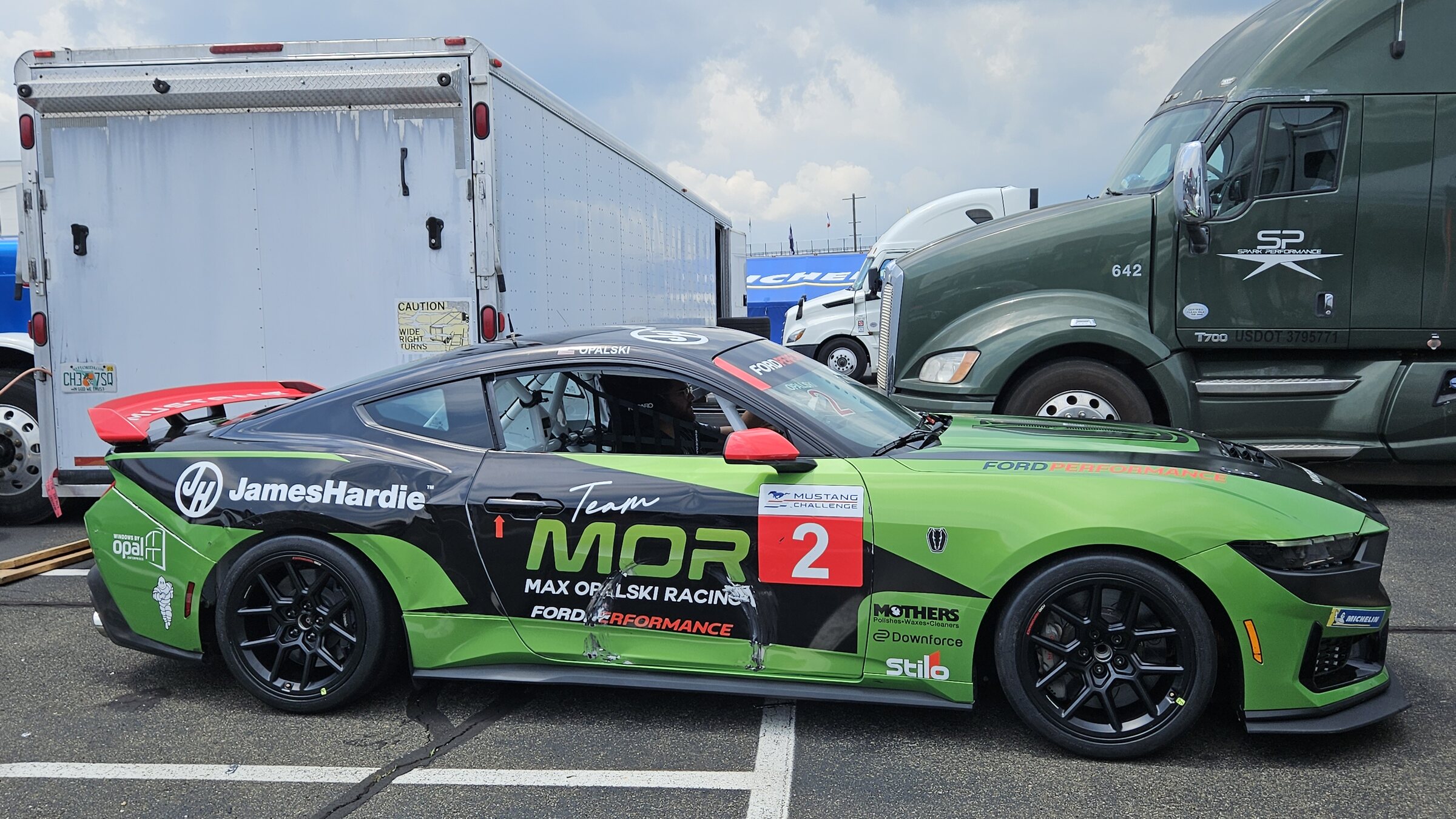
Ford Motor Company has found a relatively capital-light way to internationalise its Mustang one-make business: combine three already planned customer-racing events, score them as a separate championship and let owners decide whether the global contest supplements or replaces a regional campaign.
The Mustang Challenge Global Invitational Championship, announced on 14 October 2026, will run at Daytona International Speedway, Spa-Francorchamps and Mount Panorama in 2027. Every round will use the Mustang Dark Horse R. Ford says drivers may enter the three-round invitational on its own or alongside Mustang Challenge North America, Mustang Cup USA or Mustang Cup Australia.
This is more than a calendar announcement. It is a distribution strategy for a customer-racing product. Ford is taking cars, operators and race meetings that already exist in three markets and adding a new competitive layer across them. The model expands the experience sold to customers without requiring Ford to create a conventional stand-alone world series, book an entirely separate calendar or ask every regional entrant to fund intercontinental travel.
For teams, suppliers and promoters, that distinction matters. The commercial opportunity sits not only in entries, but in freight, preparation, spares, consumables, technical support, hospitality and partner activation around three high-profile endurance-racing weekends.
One championship assembled from existing assets
The opening round is scheduled for 22-24 January at Daytona, where Mustang Challenge North America will begin its 2027 season during the Roar Before the Rolex 24 weekend. Spa follows on 24-26 June as a support event to the 24 Hours of Spa. The championship then closes at Mount Panorama on 29-31 October during the Mustang Cup Australia finale, according to the calendar reported independently by Sportscar365.
Ford is therefore not buying three blank weekends and building an event operation from the ground up. Daytona is already a North American championship round. Bathurst is already part of the Australian series. Spa had already been announced as a global invitational. The new product is the points structure that links them, plus the sporting, logistics and commercial packaging needed to make that structure credible.
Sportscar365 reports that the format covers six races across the three meetings. Ford says the points table will be separate from each full-season championship. The Spa round will count toward the global invitational but not toward the regional series, protecting competitors who cannot justify the European trip from losing ground at home.
That separation is the key design choice. A mandatory global component could weaken regional grids by making a domestic season dependent on two long-haul trips. An optional championship turns the same travel into an upsell. Customers can choose a regional season, a three-event international programme or both.
The structure also broadens the addressable pool. A driver does not need to be committed to one of Ford's full regional seasons to contest the global championship. In principle, that gives existing Dark Horse R owners and teams a defined route into prominent events while allowing Ford to keep its North American, US Cup and Australian products intact.
The Dark Horse R becomes the common commercial unit
One-make racing works when the car is more than a piece of hardware. It is the base unit around which entries, technical support, parts supply, tyre use, driver services and hospitality are sold. The global invitational gives the Mustang Dark Horse R another use case without introducing another vehicle specification.
Ford describes the Dark Horse R as the official car of Mustang Challenge and Mustang Cup. Its road-car-derived package includes a naturally aspirated 5.0-litre V8, a Borla racing exhaust, a Recaro FIA seat, Brembo brakes, Apex forged wheels and dedicated slick tyres for competition. Sales and service are managed by Multimatic, according to Ford's vehicle page.
For an owner, the international championship potentially raises the utility of the same asset. A car bought for domestic competition can also be entered at bucket-list venues. For Ford and its service network, each additional event can generate demand for preparation, inspection, replacement parts and technical support. For teams, it creates another programme to sell to funded drivers without first acquiring a different category of car.
That is the logic behind the calendar. Daytona, Spa and Bathurst are not interchangeable club meetings. They are globally recognised venues attached to established endurance-racing weekends. The customer is buying access and context as much as track time.
The idea already has a proof point. Ford says more than three dozen Dark Horse R cars competed in the 2025 Mustang Challenge Le Mans Invitational, the first Mustang Challenge event held outside the United States. Ford Racing customer-racing manager Chris Ward said that Le Mans and the planned Spa invitational inspired the new championship. The 2027 format converts that episodic demand into a repeatable product with a title to win.
Calendar design is doing logistics work
International customer racing is constrained by time as much as by money. Cars, spares and equipment must move between continents; teams need customs documentation, insurance, freight bookings and local support; drivers and crew must fit long-haul travel around their domestic programmes.
Ford has already altered its North American calendar around that problem. Mustang Challenge North America stops after Laguna Seca on 2 May and does not resume until Virginia International Raceway on 20 August. Ford calls that interval a global invitational pause and says it is intended to give competitors time to send personnel and equipment to Belgium and back without missing a regional round.
That pause turns scheduling into a commercial enabler. It reduces the sporting penalty attached to accepting the Spa invitation and gives freight providers, team operators and technical partners a more workable delivery window. The separate points table performs the same function on the competition side: customers who stay home remain eligible in their domestic championship.
The Bathurst finale presents a different challenge. It sits after the North American season is scheduled to end at Road Atlanta on 9 October, leaving roughly three weeks before the Australian event. That sequence may allow North American entrants to complete their domestic obligations first, but the practicality will depend on the logistics package Ford ultimately offers, including whether cars are shipped, leased locally or supported through pooled inventory.
Ford has not yet published those operating details. The business case should therefore be assessed as a platform design, not as a guaranteed low-cost global campaign. Long-haul freight, temporary imports, damage repair and crew travel can still make a three-round series expensive even when the race weekends already exist.
A new sales layer for teams and suppliers
The invitational creates several distinct packages that teams can take to market.
The first is a complete arrive-and-drive programme for a customer who wants only the three global rounds. That proposition can bundle car access, preparation, engineers, mechanics, freight, accommodation, coaching and event services into one price. The second is an extension for an existing regional driver, adding the international rounds to a domestic season. The third is asset support for an owner who has a car but needs a team or logistics partner in another market.
Those packages need not be delivered by a single organisation. A North American entrant could retain its home team at Daytona, work with a European operator at Spa and use an Australian team at Bathurst. Alternatively, one team could transport the car and core staff throughout. Both models create supplier demand, but the value is distributed differently between freight specialists, regional race shops and factory-appointed support.
The common car specification makes such handovers more plausible. Setup data, spares lists and service procedures can travel with the programme even if some personnel change. That standardisation is one reason manufacturers use one-make categories to build customer-racing ecosystems: the competition product can be replicated while technical variability is controlled.
Suppliers should nevertheless wait for the regulations before committing capacity. The announcement does not yet specify tyre allocations, fuel arrangements, freight partners, parts depots, technical inspection procedures or whether central services will be mandatory. Those choices will determine which revenue sits with Ford and appointed partners, and which work remains open to competing vendors.
Promoters gain an exportable support-race story
For host events, the championship offers more than another grid. It brings an international narrative that links three markets and gives each meeting a role in a championship arc: Daytona opens it, Spa provides the mid-season international showcase and Bathurst decides it.
That can be useful for ticketing, content and sponsorship. Drivers arriving from different regional series give promoters local stories to export and visiting competitors to introduce to domestic audiences. The Mustang brand supplies a recognisable identity, while the Dark Horse R creates visual consistency across all six races.
The model also shares audience acquisition. Ford can market the same championship to North American, European and Australian customers and enthusiasts while each host event retains its own headline product. The global invitational does not need to carry the full commercial burden of a stand-alone event because it sits inside weekends already built around the Rolex 24, Spa 24 Hours and Bathurst racing.
For sponsors, the structure could support either global or round-specific rights. A partner seeking three-continent reach can follow the championship, while regional brands can activate around a single meeting. Ford has not announced the rights inventory, but the architecture naturally creates both levels.
The unanswered questions will decide conversion
Ford has confirmed the concept, venues, eligible car and entry choice. It has not yet disclosed entry fees, field limits, prize structure, freight support, car-leasing options, television distribution, hospitality inventory or commercial-rights packages. It has also not named participating teams or drivers.
Those omissions are material because interest does not automatically become entries. The 2025 Le Mans invitational demonstrated that a large grid can be assembled for one marquee occasion. A championship asks customers to commit to three different markets over ten months, with a points campaign that only becomes meaningful if enough drivers attend every round.
The strongest conversion tool may be operational certainty. Early publication of freight windows, local support arrangements and damage-contingency plans would let teams quote programmes accurately. Clear rules on substitute cars and shared personnel would reduce the risk that an incident at one round ends a customer's championship for reasons unrelated to budget or driving.
Commercial packaging matters too. A global entry that includes central logistics, event access and consistent hospitality would be easier to sell than three separately negotiated weekends. Conversely, flexibility can attract owners who already have regional relationships and do not want a compulsory all-inclusive service.
The balance Ford chooses will reveal whether the invitational is primarily a brand experience, a competitive ladder, a utilisation programme for existing cars or a scalable customer-racing business. It can serve all four purposes, but the regulations and service model will determine which one leads.
Why the model matters beyond Mustang
The significance for the wider motorsport industry is the way Ford is expanding internationally. A manufacturer does not always need to launch a full world championship to create a global product. It can connect the crown-jewel rounds of regional series, establish a separate score and design the calendars so participation remains optional.
That approach lowers some of the fixed risk. It relies on existing promoters, sanctioning relationships, cars and customer bases. It preserves regional entry products while testing demand for international travel. If participation is strong, Ford gains evidence for additional rounds or services. If demand is limited, the regional championships continue without depending on the global table.
The model is not frictionless. The cost of moving cars remains real, and customers may value one bucket-list event more than a season-long points contest. Yet the structure gives Ford a way to measure that preference with actual entries rather than surveys.
For teams and suppliers, the immediate opportunity is to prepare modular offers before the remaining rules arrive: regional car support, end-to-end logistics, cross-market crew partnerships and three-round driver programmes. For promoters and sponsors, it is a new layer of international inventory built on weekends that already command attention.
Ford has not created a new global championship by replacing its local products. It has created one by linking them. That is the commercial experiment to watch in 2027.
Sources and further reading
- Ford Racing championship announcement, 14 October 2026 ↗
- Sportscar365 independent report, 14 October 2026 ↗
- Ford Racing 2027 Mustang Challenge North America schedule, 20 August 2026 ↗
- IMSA 2027 Mustang Challenge schedule, 21 August 2026 ↗
- Ford Mustang Dark Horse R product and service information ↗
- Ford record of the 2025 Le Mans Invitational ↗
- Licensed image record ↗