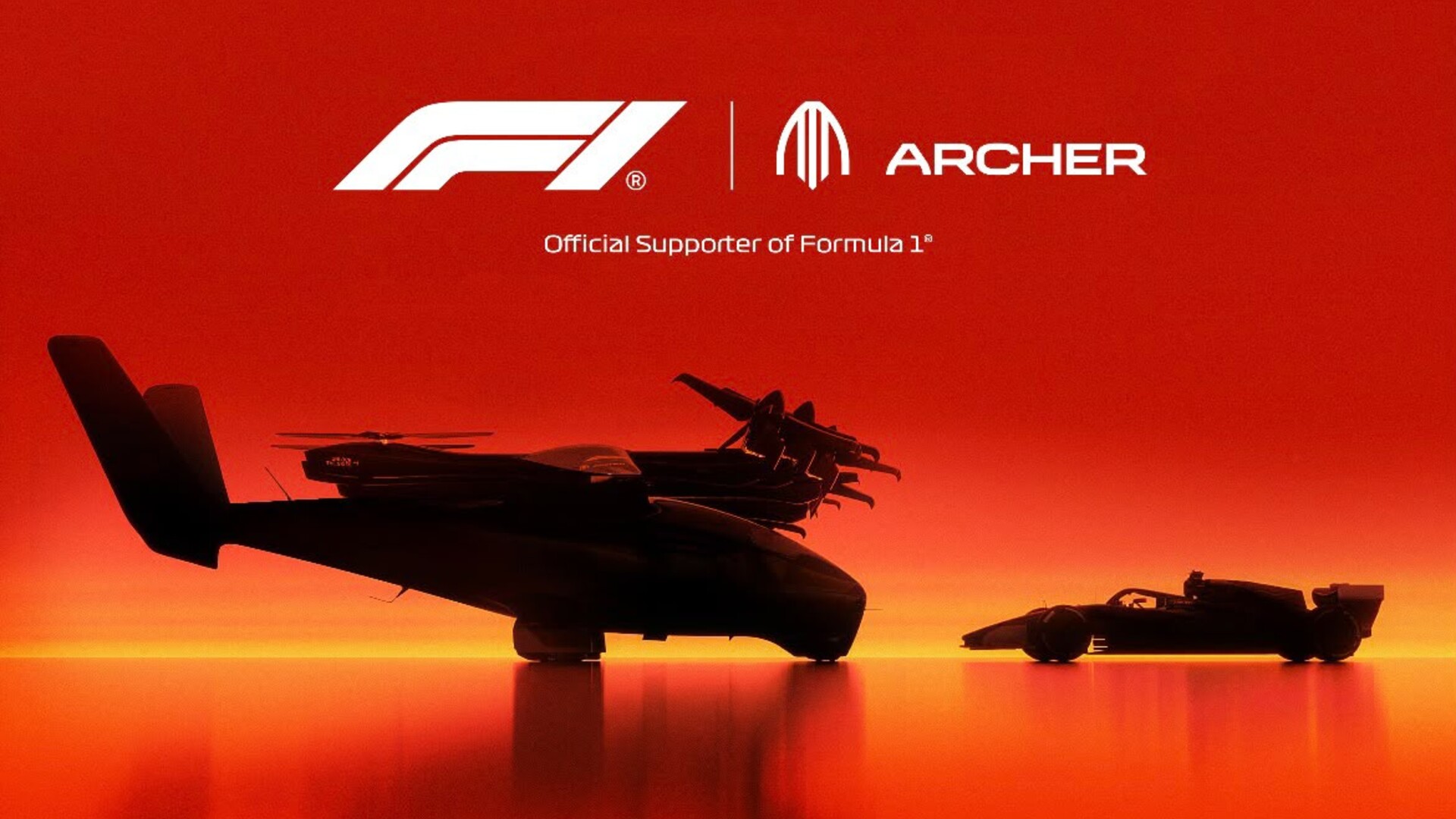
Archer's new Formula 1 agreement is more than a conventional display-and-branding package, but it is not yet a race-weekend transport contract.
The electric-aircraft company has become an Official Supporter under a multi-year agreement announced on 12 November. It will activate at selected Grands Prix in markets where it plans to operate and will work with Formula 1 to explore future electric vertical take-off and landing flights for VIPs, fans and stakeholders.
That wording matters. The confirmed asset is a sponsorship platform with selected-event presence. The proposed operating layer — dedicated pick-up and drop-off locations at circuits, passenger flights and possible inclusion in hospitality or ticketing products — remains subject to regulatory approval and further agreements.
For Formula 1, the structure offers an innovation partner and a potential new premium service without committing the championship to an immediate network. For Archer, it connects audience acquisition with physical demonstrations in cities that resemble its intended launch markets. The commercial value will depend on whether those two layers eventually meet.
Sponsorship becomes a market-entry tool
Most sponsorships move attention toward an existing product. Archer is trying to use F1 while its core passenger service is still being certified, demonstrated and introduced to regulators, infrastructure partners and prospective customers.
The initial activation map follows that strategy. Archer displayed its Midnight aircraft at the 2026 United States Grand Prix in Austin and plans displays at Las Vegas and Abu Dhabi. Formula 1 says future presence will be concentrated in relevant markets across the United States, Middle East, Asia and Europe rather than distributed uniformly across the calendar.
Archer has already announced planned air-taxi networks in Miami and Texas, giving the partnership a geographical connection to F1 events in Miami and Austin. Its Texas plan covers Austin, Dallas-Fort Worth and Houston, while its Miami concept links the wider South Florida region. These are company plans rather than guaranteed F1 routes, and the Formula 1 agreement does not confirm that either Grand Prix will host passenger flights.
The strategic logic is clear. Race weekends concentrate affluent leisure customers, corporate guests, international visitors, public authorities, investors and infrastructure operators in one place. That makes a Grand Prix useful for product education, stakeholder meetings and customer research before a full transport service exists.
It also gives Archer a way to move from a static aircraft display toward a demonstration of the complete customer journey. A future package could combine booking, security, ground transfer, terminal access, flight and hospitality admission. Formula 1 and Archer explicitly identify hospitality and ticketing as areas to explore, but they have not announced a product, price or revenue-sharing arrangement.
A race weekend is a demanding operating environment
If flights are introduced, the operational problem will be more complex than placing an aircraft near a circuit. Grand Prix demand is concentrated around short arrival and departure windows, with temporary road closures, restricted access, elevated security and airspace coordination requirements.
Promoters would need to establish where aircraft could land, how passengers would move between a vertiport and the venue, who controls security screening, how charging and maintenance are supplied, and what happens when weather or airspace restrictions interrupt service. Slot allocation would have to work alongside emergency services, television helicopters and other event aviation.
The partnership announcement does not assign those responsibilities. It does not identify a circuit operator, airport, vertiport owner, energy supplier, ground-handling company or local authority that has committed to an F1 service. It also does not disclose who would fund temporary or permanent infrastructure.
Those gaps are normal at an exploration stage, but they define the supplier opportunity. Potential packages span charging hardware, grid connections, battery management, landing-site engineering, passenger processing, baggage policy, digital booking, insurance, maintenance, ground transport and contingency planning. Promoters should expect each market to require a different regulatory and infrastructure stack rather than one global template.
Capacity is another constraint. Archer describes Midnight as an aircraft designed for a pilot and four passengers. Even a frequent service would initially move a small share of a Grand Prix crowd. The most realistic early use is therefore premium mobility for a limited customer group, not mass transit to replace trains, buses or road access.
That limitation does not remove the value. Premium transport can support higher-yield hospitality, demonstrate reliability in a visible environment and establish a reference operation for corporate customers. The key is to measure it as a high-value service and market-entry programme rather than a solution to total circuit congestion.
Regulatory progress is not the same as passenger clearance
Archer's timing is supported by recent regulatory and flight-test progress, but commercial passenger operations still depend on approvals that the sponsorship agreement cannot provide.
On 9 November, Archer said Midnight had received an FAA Market Survey Special Airworthiness Certificate, enabling market-survey operations in Los Angeles as it prepares for the United States eVTOL Integration Pilot Program and the 2028 Olympic Games. That certificate supports demonstrations and operational learning; it is not a general authorisation to sell scheduled passenger flights at Grands Prix.
Archer already holds a Part 135 air-carrier certificate, a Part 145 repair-station certificate and certification for its pilot-training academy. Its own regulatory disclosures make clear that Midnight still needs aircraft-level type certification and the additional approvals applicable to each operation. International race cities add local aviation authorities, airspace rules and infrastructure permissions.
Formula 1's release states that any future service is subject to regulatory approval. MRI has therefore not treated displays in Austin, Las Vegas or Abu Dhabi as evidence that passenger operations are imminent at those races.
For promoters, the practical lesson is to separate three milestones: an aircraft display, a demonstration flight and a paid passenger service. Each demands a different contract, risk allocation and approval pathway. Marketing material should make those distinctions equally clear so that fans and commercial partners understand what has actually been authorised.
The financial context raises the measurement bar
Archer is pursuing the partnership while funding aircraft development, certification, production and a broader aerospace expansion. Its third-quarter filing reported $5.1 million of revenue, a $274.6 million net loss and $1.3536 billion in cash, cash equivalents and short-term investments at 30 September 2026.
The same filing said operating expenses increased as the company expanded Midnight flight testing, certification work and production activity. Archer is also working toward acquisitions of Wisk, Insitu and SkyGrid, subject to closing conditions, as it develops a wider commercial and defence portfolio.
Those numbers do not prove whether the F1 partnership is expensive or efficient because neither party disclosed the sponsorship fee, activation budget, duration beyond "multi-year" or category exclusivity. They do show why a public company should connect the rights package to measurable commercial milestones.
Useful indicators would include qualified customer leads, corporate demonstrations, government and infrastructure meetings, hospitality conversion, city-specific demand data and progress toward an operating agreement. If flights begin, additional measures could include passenger yield, aircraft utilisation, turnaround time, on-time performance and the cost of temporary infrastructure.
Formula 1 can use a similar framework. The championship should distinguish sponsorship income from any later ticketing, hospitality or service revenue and clarify how benefits are shared with local promoters. A global rights agreement does not automatically grant access to land, power, airspace or venue operations controlled by other parties.
What teams, sponsors and promoters should watch
The deal illustrates a broader shift in motorsport sponsorship: emerging mobility companies increasingly want the event to act as a demonstration environment, customer-acquisition channel and stakeholder convening platform at the same time.
That model can create more durable value than logo exposure, but it requires precise contracting. Rights holders need to define whether a partner receives branding only, preferred-supplier status, data access, hospitality inventory, operational access or an exclusive right to negotiate future services. Suppliers need to know which obligations sit with the championship and which require separate promoter agreements.
Teams can also learn from the market alignment. Archer is not promising identical activation at every race. It is selecting events that overlap with intended commercial markets. Sponsors with geographically limited operations may generate better returns from fewer, more operationally relevant events than from a uniform global package.
The next material evidence will be a named circuit, regulator and promoter agreeing a defined flight programme. After that, infrastructure, operating dates, passenger eligibility, pricing and contingency arrangements will determine whether the concept becomes a repeatable race-weekend product.
Until then, the partnership should be valued for what it already provides: a multi-year F1 marketing platform tied closely to Archer's market map, with an option to develop premium mobility services. Its business significance lies in that connection between sponsorship and market entry — not in assuming that air taxis are already scheduled to fly fans to a Grand Prix.
Sources and further reading
- Formula 1 official announcement, 12 November 2026 ↗
- Archer investor announcement, 12 November 2026 ↗
- Archer Q3 2026 results, filed with the SEC on 9 November 2026 ↗
- Archer Form 10-Q, quarter ended 30 September 2026 ↗
- Archer Texas network announcement, 23 October 2026 ↗
- Archer Miami network announcement ↗
- AeroTime independent report, 12 November 2026 ↗