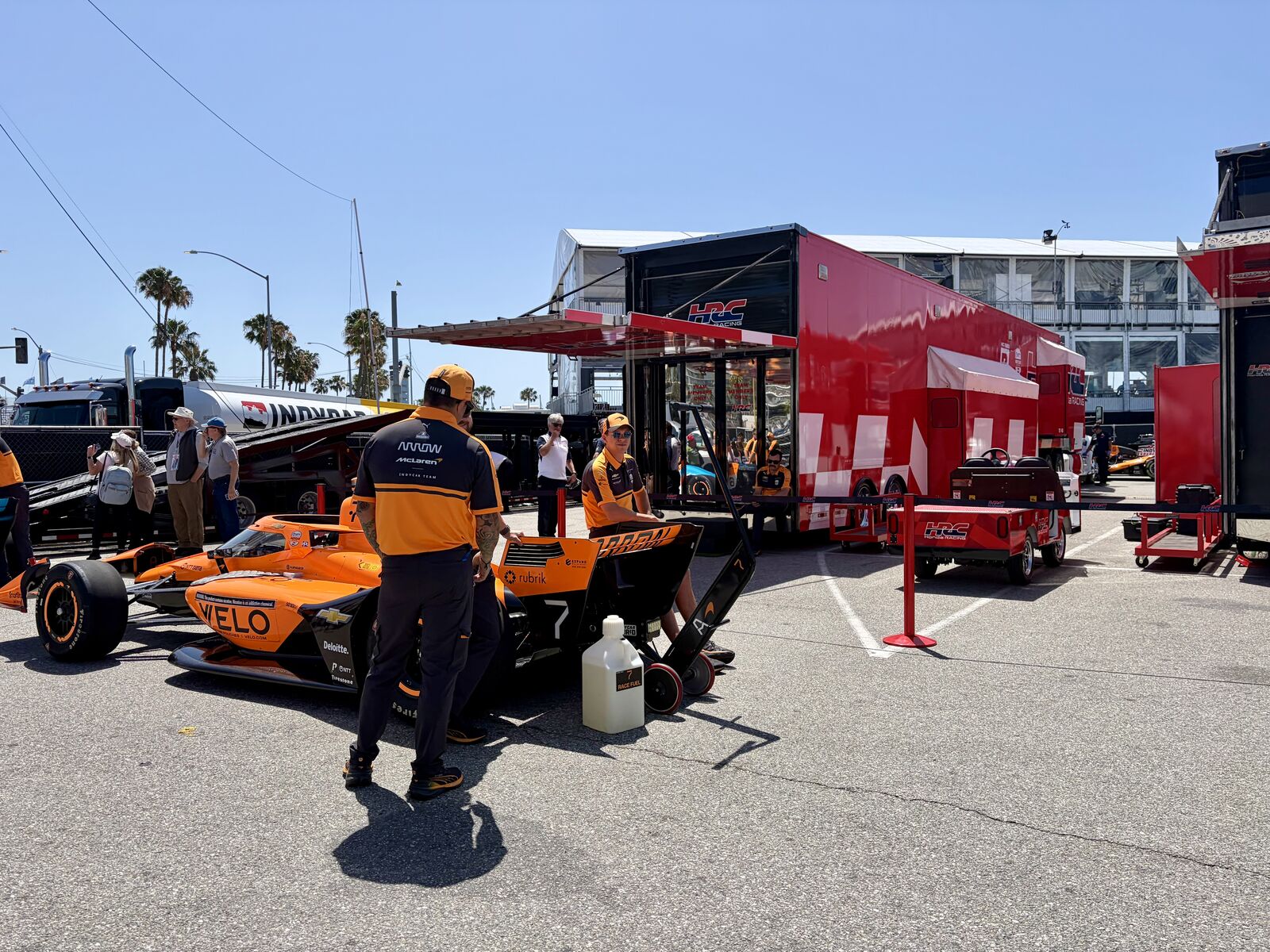
Arrow McLaren has fixed one of the largest variables in its 2028 technical programme before the new IndyCar has completed development.
The team announced a multi-year extension with Chevrolet on 6 October, retaining the manufacturer as its engine partner as the Dallara IR-28 chassis, revised hybrid system and supporting components move through validation. Neither party disclosed the contract value, exact expiry date, performance clauses or exclusivity terms.
The absence of those commercial details matters, but it does not diminish the operational signal. A team entering a major rules transition has chosen continuity in the part of the package that affects vehicle installation, cooling, electronics, simulation, calibration, spares and trackside support.
For teams and suppliers, the agreement is less about preserving a badge on the engine cover than deciding who will share data and engineering responsibility during a compressed development cycle. For sponsors and promoters, it confirms that one of IndyCar's most visible teams will carry an established manufacturer relationship into the championship's next product cycle.
Independent reporting from RACER says the alliance is expected to continue through at least the end of the decade. The public announcements describe only a multi-year term, so MRI is not treating 2030 as a disclosed contractual end date.
Continuity has a measurable integration value
Arrow McLaren and Chevrolet have worked together since McLaren entered IndyCar full-time with Schmidt Peterson Motorsports in 2020. McLaren says the programme has delivered 14 wins, 54 podium finishes and 13 pole awards across seven seasons.
The more relevant current measure is the quality of the working baseline. According to McLaren and RACER, Arrow McLaren produced Chevrolet's highest-finishing driver at 11 of the 18 races in 2026. RACER reported that Pato O'Ward and Christian Lundgaard contributed five wins, more than any other Chevrolet team, while Lundgaard completed every racing lap and O'Ward missed only one.
Those results do not guarantee that the same relationship will be optimal under the new package. They do show that the team and manufacturer already have functioning processes for calibration, reliability, trackside decisions and post-event analysis. Replacing the engine partner at the same time as the chassis and hybrid architecture changed would force the organisation to rebuild those interfaces while learning the car.
Technical continuity has a financial value even when the supply price remains confidential. It reduces duplicate tooling, avoids parallel installation studies and lets staff carry existing methods into the next programme. It also gives purchasing teams a firmer base for second-tier commitments in cooling, wiring, fabrication, sensors, test equipment and service support.
That value should not be confused with zero change. A long-term extension creates the framework for collaboration; it does not remove the cost of developing the package. Teams will still need new parts, updated rigs, software work, stock policies and training. The advantage is that those investments can be planned with a known manufacturer rather than held behind a supplier decision.
IR-28 turns the engine deal into a systems contract
IndyCar's official IR-28 programme is broader than a new tub. The series says the car will introduce revised aerodynamics, a lighter and more integrated aeroscreen, increased power and energy storage, a lighter transmission and new safety structures.
The hybrid system is also moving from the current supercapacitor-based arrangement to a battery energy-storage system supplied by BOLD Technology. IndyCar says the battery will provide approximately 14 times the energy capacity of the present system. Helix is supplying the electric drive element, while Xtrac will continue as transmission supplier with a gearbox expected to save 25 pounds.
Those components create a connected development problem. The combustion engine, electric motor, battery, gearbox, cooling system, control software and chassis packaging cannot be optimised independently. A change in one area can alter heat rejection, weight distribution, deployment strategy, service access or the load carried by another component.
That is why Arrow McLaren team principal Tony Kanaan and General Motors competition vice-president Eric Warren both emphasised closer engineering collaboration in their announcement. Their statements describe a relationship expected to contribute to the next car and powertrain, not a simple transaction for identical engines delivered each weekend.
For the supply chain, the lesson is that headline contracts increasingly govern an integration network. A nominally standard or controlled component still creates work for specialist businesses around it. The strongest suppliers will be those that can show how their product behaves inside the complete system, provide traceable test evidence and respond quickly when the specification changes.
The extension also gives Arrow McLaren and Chevrolet more reason to align their test plans early. Dyno time, simulation models, prototype manufacture and track running are scarce resources. Committing before the final competitive package is frozen lets both sides reserve capacity and decide which questions must be answered on a rig, in simulation or on a test car.
The contract transfers uncertainty rather than eliminating it
No public source defines the allocation of cost or risk between Arrow McLaren and Chevrolet. The parties have not said who funds additional test work, owns jointly generated intellectual property, carries the cost of late specification changes or supplies emergency inventory.
Those omissions are normal in a competitive manufacturer agreement, but they are the clauses that determine whether continuity produces a genuine operational advantage. A multi-year term only creates stability if engineering access, delivery standards, change control and escalation routes are equally clear.
The new architecture also introduces suppliers outside the direct team-manufacturer relationship. BOLD, Helix, Xtrac, Dallara, Chevrolet and Arrow McLaren will each own part of the package. That increases the importance of interface control: agreed data formats, hardware envelopes, software versions, validation responsibility and failure reporting.
Teams should therefore read the deal as an early risk allocation decision. Arrow McLaren has removed the possibility of an engine tender distracting the organisation during the IR-28 ramp-up. In exchange, it has committed its competitive programme to Chevrolet's development direction and delivery performance for multiple seasons.
That trade is common in motorsport procurement. Optionality has value when specifications are uncertain, but too much optionality delays design decisions and weakens supplier commitment. Locking the principal partner early can be rational when the cost of keeping two architectures open exceeds the benefit of a later choice.
The evidence to watch is not another partnership announcement. It is whether the team and manufacturer disclose completed milestones: installation sign-off, dyno hours, representative hybrid testing, cooling validation, test-car mileage and a reliable spares plan before the 2028 competition debut.
Suppliers gain a clearer sales window
The extension gives businesses below the powertrain tier a more defined route into the programme. A known engine partner allows potential suppliers to tailor proposals to a real technical architecture rather than a generic future-car brief.
Fabricators can discuss installation hardware and serviceability. Electronics companies can demonstrate compatibility with established team and manufacturer processes. Simulation providers can model the interaction between energy deployment and chassis performance. Test-equipment suppliers can price fixtures and instrumentation against a known development timetable.
The commercial opportunity is not automatic. Arrow McLaren and Chevrolet may retain substantial work in-house, and IndyCar's controlled components limit where teams can differentiate. Suppliers still need evidence that their offer reduces mass, lead time, failure risk or engineering hours within the regulations.
The strongest pitch will quantify the cost avoided during transition. A component that is only marginally faster may be less valuable than one that arrives with validated data, stable manufacturing capacity, short replacement lead times and engineers available at the test programme's critical points.
The agreement may also support technical marketing. Chevrolet can present the programme as evidence of engineering continuity through a new hybrid generation, while specialist suppliers can pursue approved case studies around manufacturing or validation. Any such rights would need separate permission; a technical contribution does not automatically grant public use of team or manufacturer brands.
For companies planning investment in IndyCar capability, the timing signal is useful. The principal parties are moving from concept and early validation toward integration. Equipment, people and production capacity that must be ready for 2028 will be commissioned well before the first race of that season.
Sponsors receive a longer planning horizon
Arrow McLaren's commercial partners now have greater certainty about the technical story available to them. The team has already assembled a 2027 driver line-up of Pato O'Ward, Scott Dixon and Felix Rosenqvist. The Chevrolet extension adds manufacturer continuity behind that sporting package.
For business-to-business sponsors, the transition creates content beyond results. Engineering change, manufacturing, software, energy management, logistics and workforce development can all support customer programmes if the partnership rights allow it. A sponsor can build a campaign around the road to 2028 rather than wait for the finished car to appear.
The risk is overclaiming. The published agreement contains no financial value, guaranteed performance outcome or detailed technology-transfer commitment. Partners should base campaigns on documented milestones and access rather than assume that a long-term engine deal makes championship success inevitable.
Promoters also benefit from confirmed manufacturer participation around a leading team. Chevrolet and Honda provide recognisable consumer brands across the grid, while Arrow McLaren brings an international team identity and a high-profile driver roster. That combination supports ticketing, local dealer activation, hospitality and media narratives as the new car launches.
The value will be greatest if the series coordinates the technical rollout with commercial inventory. Demonstration runs, fan displays, supplier showcases and explainers can turn the IR-28 from an engineering expense into a marketable transition. Teams and manufacturers need sufficient lead time to approve those assets without compromising test secrecy.
Early certainty is the competitive asset
The Chevrolet extension does not reveal a novel sponsorship category or a new engine manufacturer. Its importance is timing. Arrow McLaren has made a high-consequence supply decision before the championship's next chassis and hybrid package reaches competition.
That decision should let the team sequence recruitment, tooling, test work and supplier selection around a stable powertrain relationship. It gives Chevrolet a leading customer through which to develop and validate its 2028 package. It gives partners a multi-season story and gives the wider supply chain a clearer view of where work may emerge.
The contract still leaves major questions unanswered. Term, price, service levels, test allocation and intellectual-property rules remain private. Competitive advantage will depend on how those terms work in practice, not on the length of the announcement.
For motorsport businesses, the broader lesson is direct: a rules reset rewards early decisions at the interfaces. The company that secures a principal supplier in time can design the rest of its programme with fewer assumptions. The supplier that waits for every detail to be final may find that the important capacity, access and relationships have already been allocated.
Arrow McLaren has chosen continuity before certainty. In a development cycle where every connected component must arrive together, that may be the more valuable form of certainty available.
Sources and further reading
- McLaren Racing official announcement, 6 October 2026 ↗
- INDYCAR official partnership report, 6 October 2026 ↗
- INDYCAR official IR-28 technical announcement, 28 July 2026 ↗
- INDYCAR IR-28 technical overview ↗
- RACER independent report, 6 October 2026 ↗
- Motorsport Week independent report, 6 October 2026 ↗
- Wikimedia Commons image record ↗
- Creative Commons CC0 1.0 dedication ↗